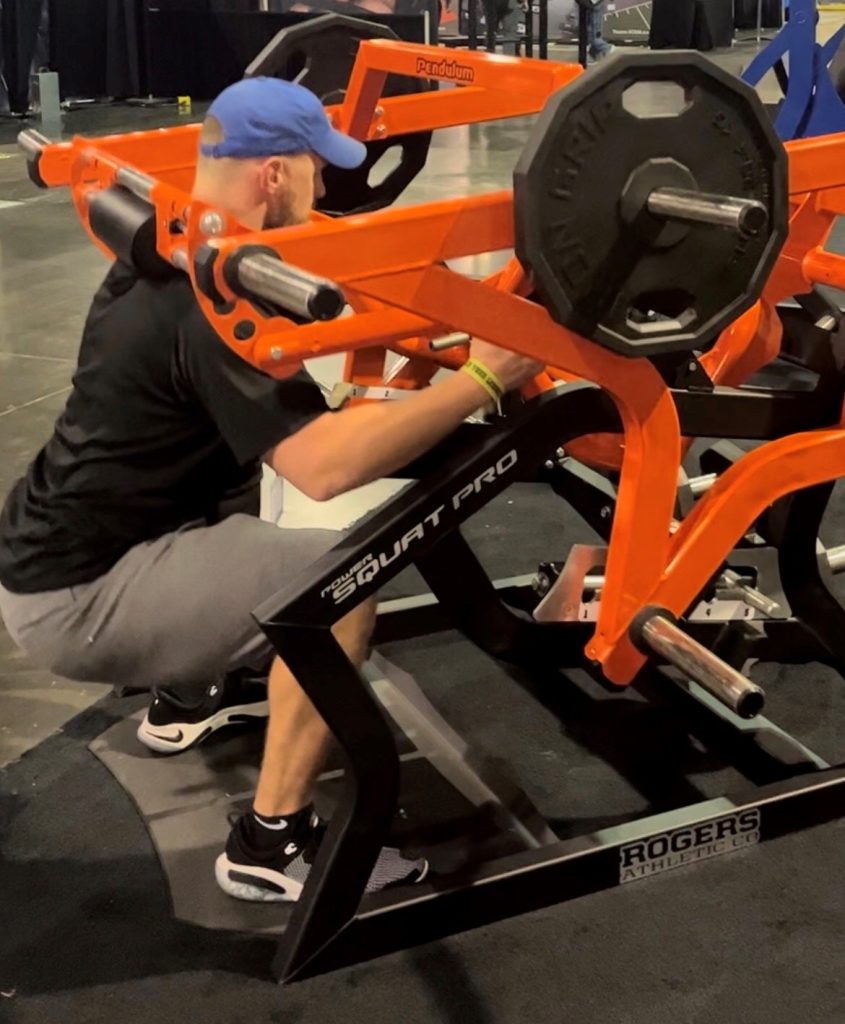
The Pendulum Seated Squat was created to meet coaches’ requests for a way to train the legs independently or bilaterally with maximum loads.
This unique linkage maintains a consistent foot angle for knee and ankle relief making this a great training or re-hab tool. The strength curve on this machine intensifies the amount of tension placed on the quadriceps and unlike other machines activates the vastus medialis so, it truly exercises the entire quadricep muscle.

(A) EXTRA-WIDE FOOTPAD
Train multiple foot positions, changing muscle emphasis.
(B) INDEPENDENT MOVEMENT
Freedom to move from fused double leg press to single leg independent action.
(C) S.E.T. (Set Extension Technology)
Allows you to go to failure quickly and safely in a variety of positions. S.E.T. (Set Extension Technology) – On the side of the seated squat is an adjustable stopper which controls the depth of movement. This can be used when training injured athletes who do not have full range of motion or to safely train athletes with poor flexibility. This can also be used for variable range training which can be very intense.
(D) ADJUSTABLE SEAT
Eighteen different seat settings to allow athletes of all sizes to train in comfort.
(E) CONVENIENT STORAGE HORNS
On board weight storage to help manage your weight plates.

Slide The Release Pin to Train an Isolateral Leg Movement