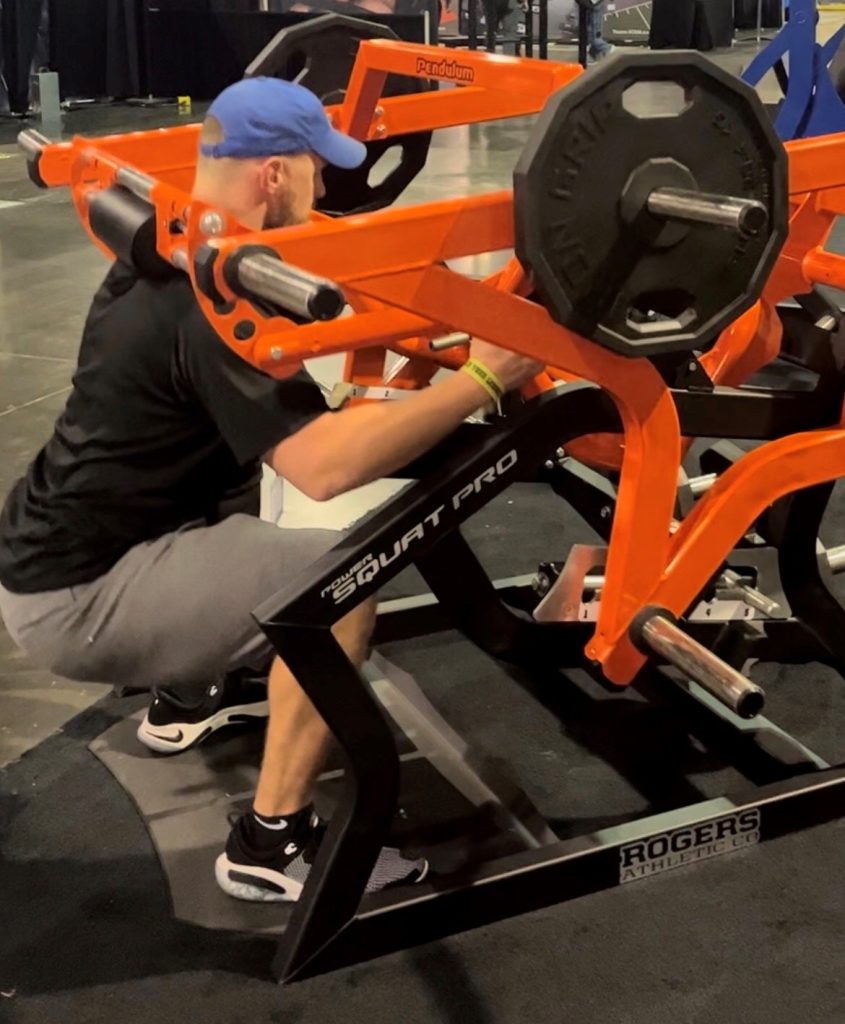
If you want to get the most out of the lunge, do not use weight and stay stationary.
Following your last set of squats or a leg press quickly get into a lunge position. Your lower leg (tibia & fibula) should be exactly perpendicular to the floor.

In the above picture the athletes right lower leg is set in the proper position. Once set, the leg must remain in this position never moving one millimeter forward or backward… never. It must remain at 90 degrees. The slightest movement means the athlete will lose muscular tension and the exercise becomes easier.

Remaining erect, the athlete lowers himself until the left knee is 1/2 to 1/4 inch off the ground and pauses for a full second (1 potato, 1 Mississippi, or 1 alligator). The athlete raises himself back to the original position, no higher and returns to 1/4 to 1/2 inch off the ground with a pause each subsequent repetition.
As the exercise progresses, balance will become a tremendous factor. Each repetition will become more difficult as the musculature used to stabilize the mobile hinge joint (your knee) and the femoral head of the femur fatigues due to diminishing strength.
Finally, as you continue the movement you will either tip over or your back knee will come to rest on the ground. Then switch legs.
This is a great exercise that requires tremendous discipline. You can not use weight with this exercise as there is no way to stabilize the femur as the musculature becomes further and further fatigued.
Doing a lunge and not lunging is a great way to Get Strong.